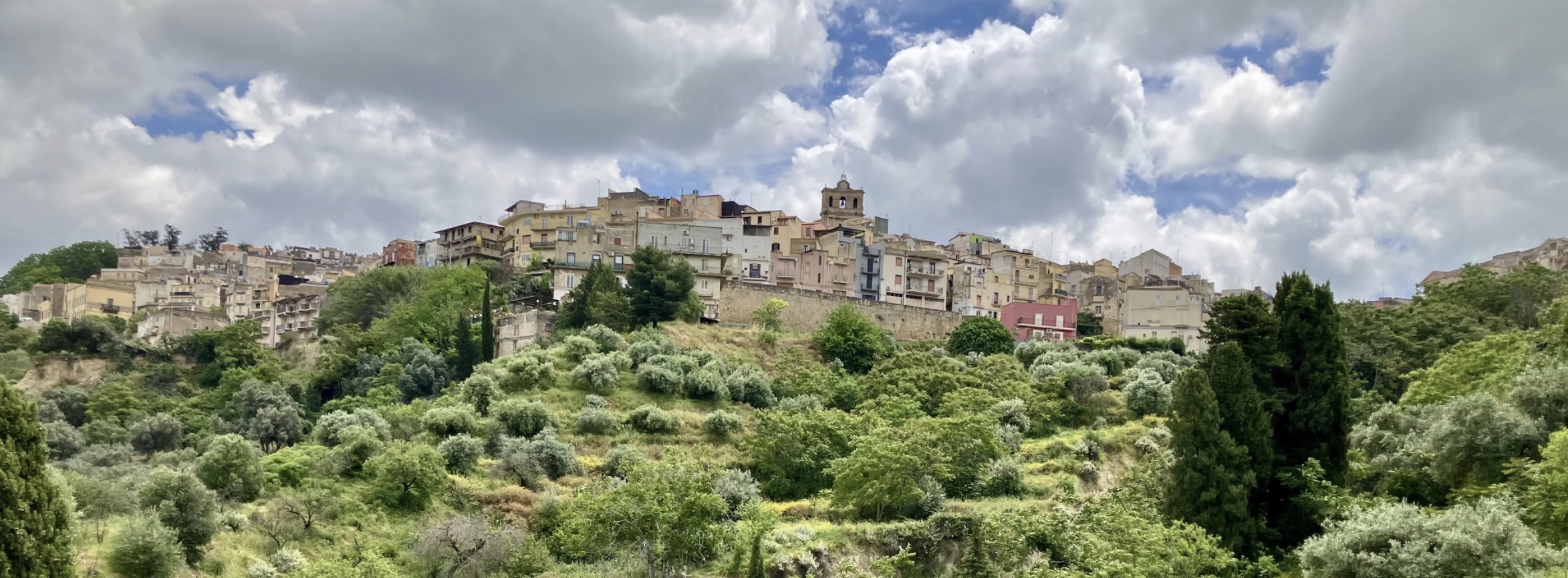
Mineo is a tiny mountaintop village in the shadow of a volcano. The place lived up to the many tales told by my nonno, who described roaming its outskirts as a kid and feasting on bountiful prickly pears, figs, and pigeons he killed with a slingshot and roasted over an open fire.
It wasn’t myth. It was love of the motherland and a sense of belonging, perhaps made sweeter by what happened in the United States, where he was deemed “enemy alien” solely for being Sicilian, a trauma of which he never spoke. He quit a prestigious job at the Ritz Carlton Hotel and became a self-taught carpenter.
The village itself rises above the agricultural plain like a child’s intricate sandcastle against the backdrop of Mount Aetna, a white-cloaked father both benevolent and fierce. The air above the village is cool and redolent with the scents of oranges and olive trees while chimney swifts circle and chirp. I wonder: Are these Sicilian swifts? Do they know I have arrived? Did their great grandparents know my Nonno and do their grandchildren recognize me, their cousin?
I wake up to the sound of…nothing. Nine-eleven quiet, when the complete absence of planes rumbling overhead told that life as we knew it was ended. Then I hear a conversation outside and roll up the bedroom’s window blind. Across the alley, on the floor below me, a nonna is sitting in the window talking on the phone. She is so close I can see the flowered pattern on her housecoat. Pigeons coo. These are the only sounds until the bells of Santa Agrippina ring nine times, like a mother’s voice, urging me out of bed. This peace is what my grandparents traded for life in America, and the rumbling of planes over Big Nonno and Big Nanna’s apartment in East Boston told that life as they knew it had ended.
My father also grew up in a tiny place where kids run around unsupervised and the loudest noise is the wind. He left after an unbearable loss. The father he idolized—a fisherman who was neither rich nor learned but by all accounts was generous, honest, and could play the rhythm bones while tap-dancing—had acute respiratory distress from the tuberculosis that was endemic in the Province in the days before widespread use of antibiotics. He was loaded into the neighbor’s car for a ride to the hospital, and my father never saw him alive again. He nailed shut a lid on his childhood when he was sixteen, and a year later, he fled his grief, and his remarried mother, by coming to the United States.
A maternal uncle and aunt took him in, and he got a job in a print shop.
“I stood behind a printer feeding in sheets of paper for eight hours a day,” my father said. “I never felt so depressed in my life. A loss like that messes with your head.”
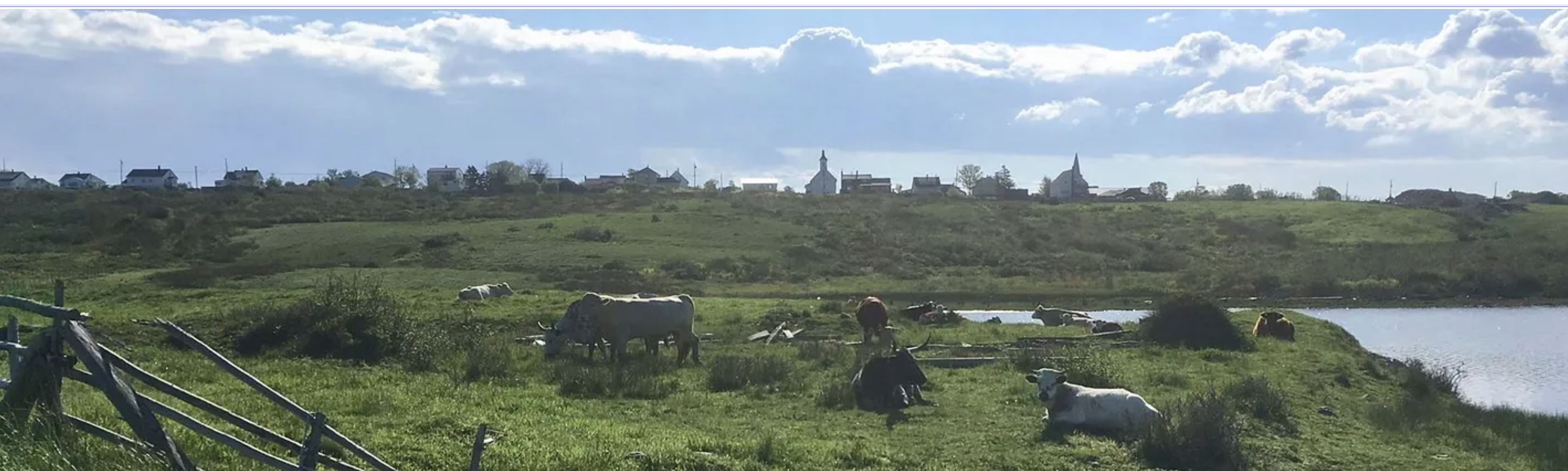
I am struck by how two very different sides of my family had some key features in common. Old women in Sandford love to sit in windows and take in the town’s goings-on.
It occurs to me that the ancestors most given to rage were immigrants from villages. Mineo, where centuries of family history unfolded in a quarter the size of a tabletop, and Sandford, where relatives lived their entire lives in a two-mile square hamlet. Perhaps their rage was proportional to the enormity of the adjustment to America and to assimilation. To life in houses separated by chain link and families scattered between opposite coasts. Neither my father nor Nonno were suited to the heartlessness of the suburbs. Moreover, both suffered traumatic homesickness, the longing attendant on rupture from the homeland, but neither possessed the insight to express it. My father locked away his childhood…and my grandfather talked about his, incessantly.
The things we do not acknowledge nonetheless take up huge psychic real estate. The empath child senses, “Something is wrong,” but can’t put a finger on it. She is told, “You are too sensitive,” but she is—in many cases—acutely tuned in to the unspoken. It’s a burden for a child, but now, it is a gift. I understand angers in that dark house of my childhood as “unmetabolized grief.” As longing and shame, and yet also of a keen love of place. I feel a vestibular shift when I stand on the ground in Mineo and Sandford, as if some part of me knows I am home.
My ancestors call to me through the land. The moss, lichens, marsh grass, and scrubby pines that cling to Nova Scotia granite are tough. To live there, you must be like them—tenacious, impervious to cold and salt, and content with the beautiful of an exacting landscape. To leave there, you must also be tough: Lichens do not peel easily off rock. Either way, if you belong to that corner of the world, you are made of stern stuff.
We cannot all return to the birthplaces of our forebears, but riches lie in our ancestry.
Each of us is one loop in an unimaginably rich fabric. We are unimportant in the best possible way, dwarfed by an indomitable truth about being human. We are more than this moment, this day, this nuclear family, this plot of land surrounded by a fence. We are more than our puny “pasts,” a few decades that feel like everything but in fact, are not. When we gaze in mirrors, we might be discerning enough to see the multitude of sailors, soldiers, farmers, cobblers, tailors, fiddlers, fisherman, bakers, builders, and perhaps even ancient kings and queens who look back at us.
We cannot clone a good version of a dysfunctional family, but we can remind ourselves that we already have an indestructible kin network and make that part of our healthy survivor selves.
 Melanie S Smith