
Blackface was as much a staple of my childhood as my beloved Bugs Bunny.
In February 2019, I was discussing the recently disclosed photograph of Virginia’s Governor Ralph Northam as one of two students, one in blackface and the other in a KKK robe and hood, in a medical school yearbook. The setting was my writing class on public health research ethics.
“Not only is the photograph not surprising to me,” I said, “it makes sense.”
Virginia, I explained, was the state that gave us a slew of our country’s most notoriously racist chapters of medical history, including Buck v. Bell, the 1927 Supreme Court case on eugenic sterilization; the so-called Racial Integrity Act to maintain purity of “white blood,” which Richard and Mildred Loving succeeded in overturning in 1967; and the Tuskegee Study of Untreated Syphilis, a 40-year “experiment” to document how syphilis ravaged a Black body, undertaken by doctors largely from the University of Virginia’s medical school and appointed by Woodrow Wilson to the United States Public Health Service. Not only did Virginia’s racist history show how the ideas of a small faction can take root and spread, it showed their singular longevity. The governor’s participation in performative racism, even in medical school, was consistent with that legacy, and thus—I said—should not come as a surprise to students of public health history.
It just happened that a colleague was observing class that day. Afterwards, he shared that he was struck by my comments about the governor. “I wouldn’t thought of that,” he said in a complimentary tone that gave me a smidgeon of pride. I walked away feeling flush with the sense of having contributed meaningfully to the current conversation about race.
Blackface: not a surprise; in fact, predictable.
Two years later, I am experiencing the exact opposite reaction: a complete surprise at the performative racism of blackface. This time, however, the offender isn’t a public figure. This time they—plural—are family members: my father’s father and my mother’s mother, respectively, long deceased persons representing two sides of my family as different as they were physically distanced. My father’s family lived in a tiny fishing village in rural Nova Scotia, and my mother’s Sicilian-immigrant parents lived in a Boston suburb. There is no shared cultural history, like that of Virginians, to explain the pantomime common to these two tribes. But the bigger piece of my surprise is the generational nearness of this familial racism. I am shocked that my forebears were so enamored of blackface that they photographed it. And I am equally shocked that I didn’t know.
Here’s how it started. It’s a pandemic, and I’ve been going nuts trying to find things to do. I began to sort boxed family photographs, scanning and labeling them for posterity. Then I found the photograph of my father’s family assembled in a village hall with what looks like practically the entire community. In fairness, all the men except my grandfather are in blackface, but my father told me his father often donned blackface to play the rhythm-bones in a local minstrel show. By the time I found the photograph of my grandfather, a fisherman whom I never knew, (and my grandmother, whom I did know, also in the picture), I had come to know how this beloved man had died of pneumonia when my father was a mere boy.
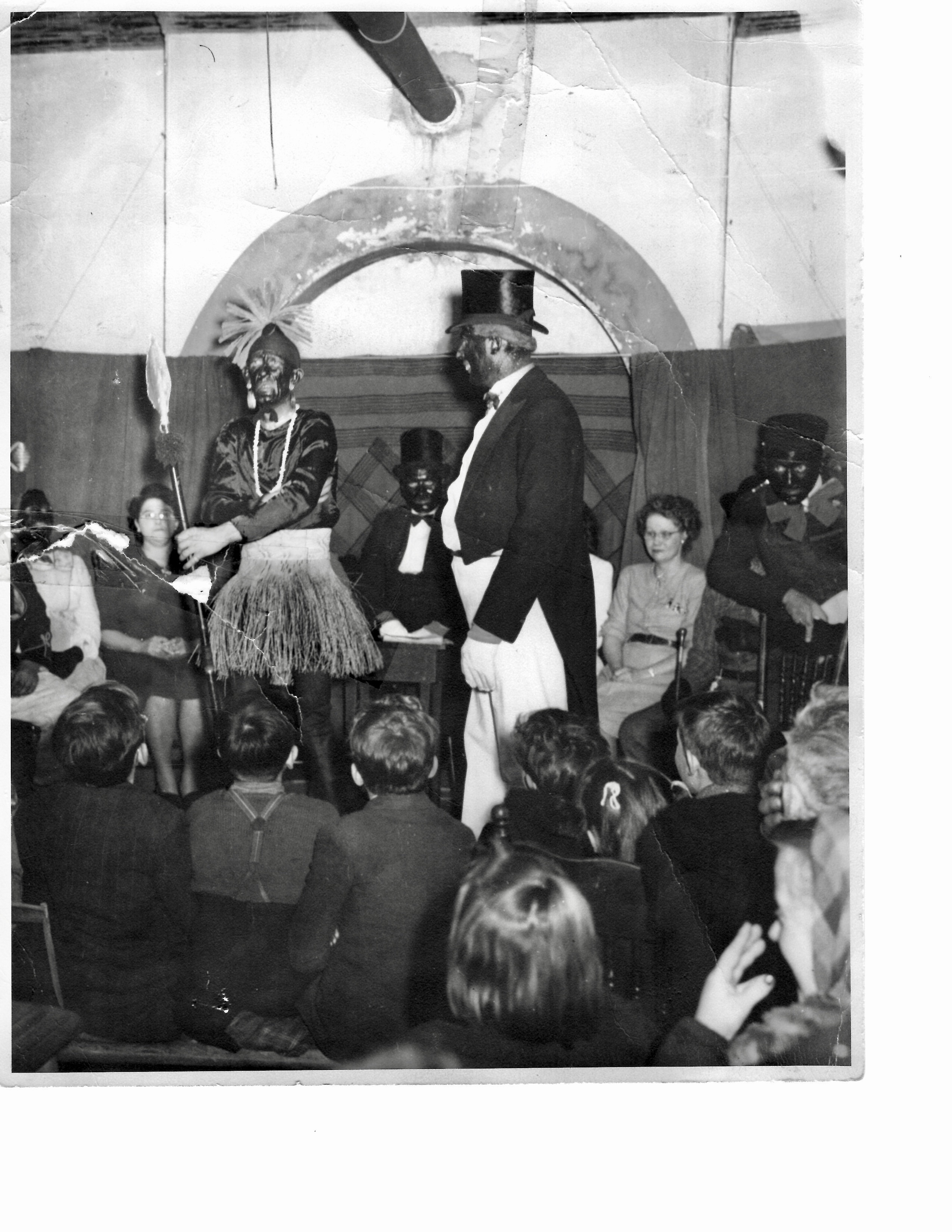
The second photograph was of my mother’s mother, or Nanna, as I called her. She wore a grass skirt, blackface, and a bone through her nose, and appeared to be dancing for partygoers. I was her eldest grandchild, and we were close. Because of her, I loved poetry; she often recited it to me as a child, and when I went away to college, she sprinkled excerpts in her letters. She imparted the family’s Sicilian lore to me, and in our long conversations shared views that were decidedly more liberal than those even of my own parents. Once in a while she expressed a view of Black people that was paternalistic (“You people have such melodic voices,” she once said to a home health aide, intending it as a compliment) but never malevolent. Three of her five granddaughters married Jewish men, and one married an Indian. None of that would have mattered to her, had she lived long enough to see it.
Studying the old photographs prompted many questions. Why did the photographs bother me? Should they bother me? When I shared my feelings, my mother said, simply, “Nanna wasn’t racist. Everyone did it.” Both were somewhat true statements, but did that erase the offense? Or was I using a 21stcentury moral lens to judge the actions of people in their prime during World War II, a decade after the blackface sensation Al Jolson was at the height of his popularity? Did I have a responsibility personally or professionally, having seen these photographs, and if so, what was it? And most baffling of all: How could I reconcile blackface in two communities so culturally and geographically different?
The answer might arise from the perceived immigrant experience of the two sides of my family, the Sicilians having landed right before the 1924 Immigration Restriction Act limited the numbers of Italians, and my father having arrived from Canada in the late 1950s, at the onset of the civil rights movement and in time to enlist to fight in VietNam in exchange for citizenship (he was rejected because of a heart defect). At lively Sunday dinners in the 1960s, the discussion of racism elicited a common response.
“Our ancestors weren’t here during slavery,” as if that defeated the argument that we could be racist.
The offending photographs had been taken between the late 1940s and early 1950s, about a decade before my birth. My Sicilian grandparents, in their fifties when I was born, described being Italian-speaking foreigners at the bottom of the immigrant hierarchy. My grandfather in particular, who had come over when he was about twelve, was a treasure trove of stories. At grade school in South Boston, he didn’t understand what it meant to be called a “Dago,” “guinea,” or “WOP.” “All it meant was ‘without passport,’” he told me with a twinkle in his eye that suggested the name-callers were merely ignorant. His explanation of “WOP” has been debunked, but the string of insults and fisticuffs with Boston-Irish kids, and later, his being identified as an “enemy alien” during World War II, told of the prejudice Italians had endured. During the enemy-alien period, my grandfather’s movement was restricted and he was required to report regularly to authorities. A “nervous breakdown” ensued, causing him to give up his well-heeled job as chief steward of the Ritz Carlton hotel. He became a successful self-taught carpenter.
Despite that trauma, my grandfather remained deeply patriotic. I learned about love of country by watching him sing the National Anthem at Fenway Park, his fedora over his heart. He railed against Republic “fat-cats,” championed unions, and celebrated Jackie Robinson’s ascension to the major league. My grandmother was no less progressive. She worked for a Jewish tailor during the war, and I grew up thinking tchotchke and oy vay, among other Yiddish words, were Sicilian because of how abundantly they laced her speech. She was a feminist long before I was, sporting an ERA bumper sticker.
My grandmother loved old musicals and the lyrics of Steven Foster, while my grandfather opined about the “golden age” of movies, when Al Jolson sang “Swanee” and the Jewish funnymen Groucho Marx and Charlie Chaplin served up social criticism.
We lived a mile from my grandparents and across the street from our cousins in a tightly knit first-generation immigrant community. Most Sundays found us at Nanna’s house, eating eggplant and artichokes and shriveled black olives. On holidays, the grandchildren dressed up in costumes my grandmother had sewn, parading across the hearth to put on musical shows. In a long skirt and embroidered shawl, I sang “I like to be in America,” from West Side Story, and everyone clapped. Afterwards we listened to old 78-rpm records of Nelson Eddie singing Pagliacci.
I enjoyed a deep sense of belonging to a culture that continues to shape my worldview.
My father’s contribution is more complicated. Not wanting to become a fisherman like his recently deceased father, he emigrated from “the French Shore” at the tender age of 19. He arrived in Boston having never seen a city and soon cultivated skill in heavy construction. But every summer, I was flown or ferried back to see “Nannie,” who lived on a bluff overlooking the ocean and still used a hand-cranked washing machine to wring out laundry. Time seemed to stand still in the village of Sandford, whose sole Black resident, an old man affectionately called “Uncle Ned,” visited her once when I was a child. He wasn’t anyone’s uncle, but I was too young to question the “Uncle Tom-ism.” I didn’t think about him until I was an adult, researching my father’s genealogy. Why was there only one Black resident in an all-white village, when on the other side of Yarmouth—the nearest big town—there was an entirely Black community? A Nova Scotia historian wrote back to say that Ned’s father was a Jamaican immigrant. He worked for a well respected village resident who ensured that the man had his own parcel of land. As I recounted this to my father, he casually shared that as a boy, he used to go hunting with Ned, because his own father was too frail.
As a kid at the dinner table, I had heard my father rail against affirmative action and the way his bosses were compelled to hire unqualified “colored people.” His views evolved; decades later, he threatened to end his friendship with a man who used racist epithets about President Obama. Still, the picture of my youthful father palling around with an elderly Black man came as a complete shock.
My mother professed to being liberal, but I remember her expressing views that suggested otherwise. Like that she didn’t oppose interracial marriage, but she “felt sorry” for the children. Years later, teaching Loving v. Virginia, I would find that the “it’s bad for the children” argument was the basis of support for anti-miscegenation laws. Once she told me that a beautiful Black woman on television clearly had “white blood” because her nose was narrow, and much later, when I discovered remote Mi’kmaq ancestry on my father’s side, that I might have been “dark” as a baby because of my “Indian blood.” I thought of my mother as a bright woman who understood prejudice from firsthand experience. As a bride visiting Nova Scotia, she endured stares at her jet-black hair and comments about how Sicilians were “close to being colored.” Such prejudice is centuries old, Sicilian Americans having been routinely characterized as “uncivilized” and racially inferior, “too obviously African to be part of Europe.”[1] She recounted the indelibly wounding experience of an in-law’s refusal of her cooking.
“I wouldn’t walk across the street for eye-talian food,” the in-law said.
The most critical question was one I hadn’t yet posed: What did the photographs mean to me? Did they change my view not of my forebears but of myself? Of my sense of responsibility to myself, as much as to students or readers of my writing? To ongoing discourse about collective white benefit from racism, including the luxury to treat it as an academic rather than personal issue? And how, if we are not explicitly working to end it, we are part of the problem?
Most immediately, the photographs compelled me to ponder racism up-close and personal. I teach material that challenges assumptions about whiteness, believing that if you grew up white in the United States, you likely did not escape the constant bath that is racial animus. There’s rarely a moment in my class when I am completely at ease with the topic, and I see that as a necessary discomfort.
The discomfort of loving people who put on blackface, however, feels worse.
I should not be surprised that my grandparents participated in blackface. The fact that I am, is key. Revisiting blackface itself was also necessary discomfort. I watched clips of Al Jolson, read about the history of minstrelsy, and re-watched the animated cartoons of my childhood. The cartoons stopped me cold. Their depictions of Black people as gullible, rhythm-driven, drool-mouthed simpletons are the very essence of blackface, and I, like others of my generation, took them in with Captain Crunch and milk every Saturday morning.
Blackface was as much a staple of my childhood as my beloved Bugs Bunny.
In focusing on my grandparents’ blackface, I had neglected its place in my own life—routine, accepted, and at one time amusing, even. The photographs of my blackfaced forebears had led me to…myself. The same society that was entertained by minstrelsy fed impressionable children racist fare as routinely as sweetened breakfast cereal. Blackface’s babies showed up in Loonie Tunes, and its great-grandchildren on the blackface sweaters Gucci sold in 2019.
Blackface is intergenerational, because racism is intergenerational.
The scholar Eric Lott argues that blackface is evidence not solely of derision, but also of attraction and even love—an object of psychological projection. Become the thing you love or hate, and you have the ability to put it away at will rather than live with the love or hate that Blackness elicits. This angle might help to explain why Black audiences loved Al Jolson, who some argue, elevated blackness. But at the end of the day, Jolson had the power to take his blackface off.
Which is all to say, the story of blackface is more complicated than one of simple mockery. I’ve thought about that particular argument as it relates to my Nova Scotia grandfather’s playing of the rhythm bones. Present in ancient Greece, the rhythm bones migrated to Scotland and Ireland, then Nova Scotia, in the instrumentation of jigs and reels. Eventually they became a staple in minstrel shows. The bones my grandfather holds in the family photograph attest to this intersection of culture and prejudice. Did he adopt blackface in a misguided homage to Black musicians? Or as a garden variety racist?
I’ll never know the answer; no firsthand account of his life remains. But blackface does, and close to home. In my tony liberal suburb of Boston, I regularly pass a lovely center-entrance colonial that prominently displays a black lawn jockey. In the era of Black Lives Matter, the dehumanization of Black people isn’t always violent.
Blackface is not a bygone relic. It is as much my legacy as is Sicilian lore or the rhythm bones. I choose to believe that, had they lived today, my beloved grandparents would understand the offense. I imagine my Sicilian grandfather’s indignation over George Floyd’s murder, my grandmother knitting of pink-pussy hats for the Women’s March, and my Nova Scotia grandfather’s rhythm-bones clacking to the uniquely American Rhiannon Giddons.
I’ve realized my discomfort is, like blackface, a mask I can take off at will.
I choose to wear it as a necessity, face forward.
#
[1] Brent Staples, “How Italians Became ‘White.’” New York Times, October 12, 2019. https://www.nytimes.com/interactive/2019/10/12/opinion/columbus-day-italian-american-racism.html
Blue Mountain Review, Summer 2021
 Melanie S Smith