
When I was fourteen, I went away to babysit for my mother’s friend while she was on vacation. I got paid to sit on the beach and watch her kids.
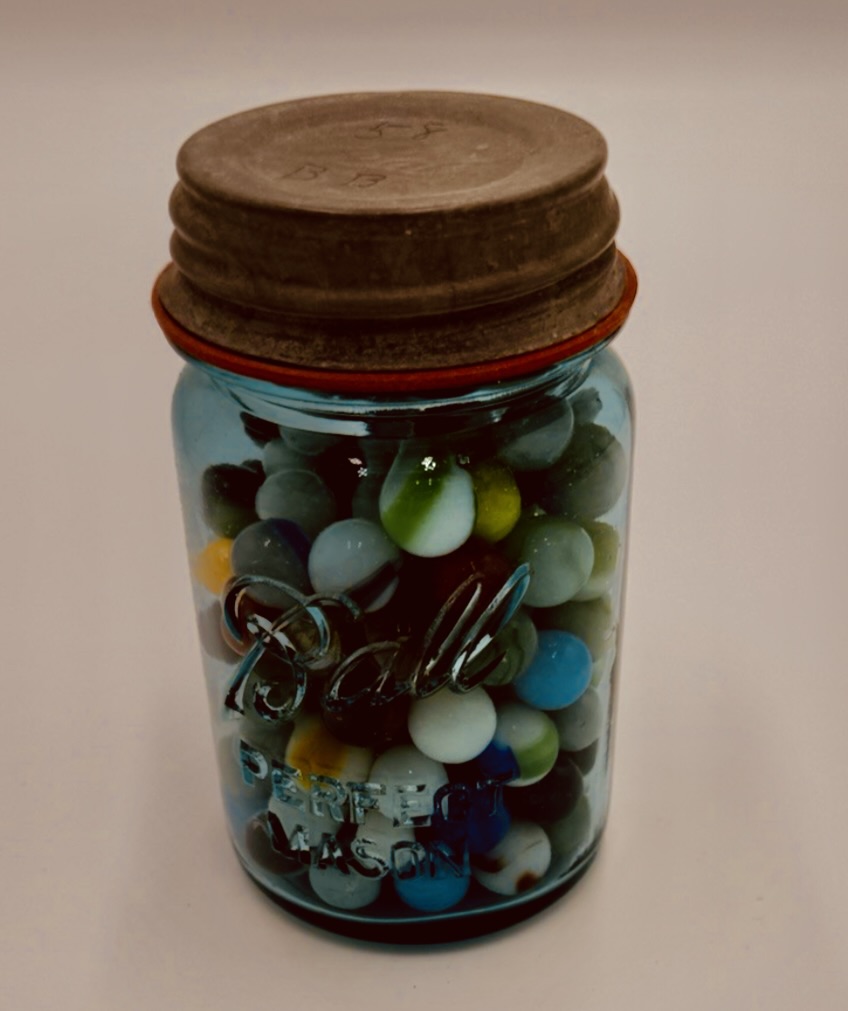
One day we all went to a flea market where I spotted a large blue mason jar filled with old marbles: cat’s eyes, red devils, yellow agate, blue and green slags, and a few rare shooters. There must have been two hundred marbles in that jar, and it cost only two dollars. My sister collected marbles, so I bought them.
I put the jar on the window sill. In the sunlight, the marbles looked like jewels, and I was tempted to keep the prettiest ones for myself. But I didn’t.
When I gave them to my sister, she screamed with excitement, and I felt like a true big sister.
My childhood selflessness didn’t end with marbles. I knew to call the police when my next youngest sister was trailed by a man in a car while toting her sack of delivery newspapers at dawn each day and later, to yell at my father that his drunken buddy was running his hands over her when he visited. I taught my youngest sister to read and how to use the metric system and wrote all my sisters letters when I left for college, the first in my family to go.
I was a good sister.
I didn’t learn how from my parents.
Crapshoot.
#
Red is the color that stains my hands as I slice and shred a beat-heart for the pickling jar. A red so plummy, I am surprised I forgot it. It’s too purple to be the color of blood but my dripping hand reminds me of when John squeezed it so hard that his IV tube backed up and a bright red thread trickled down his forearm and into my palm. That blood told how hard he fought back not against malignancy but letting me see him cry. He did so only once, when the outdoor sunflower I potted to save it from the ravage of chipmunks bloomed in late August. We pulled into the driveway after his last chemotherapy appointment and at the sight of that yellow orb, a sob escaped.
“I’m not ready to be gone,” my husband of four months wept.
At his memorial, a member of his cancer support group squeezed the same hand that had cupped his blood.
“He cried at the last meeting,” she said. “Not for himself, for you. He didn’t want to leave you all alone. He was a good man.”
That was ten years ago.
#
Lately I’ve had a kind of double vision. It began the day after I slept on a custom pillow that has a cut-out for my lower arm and a bolster to support my upper arm after shoulder surgery. But the bolster smelled like chemicals so I put it away.
The next day I was scanning shelves in a grocery aisle when the image of John’s freckled back floated up, his white-haired head with a small bald spot nesting in the pillow. A frequent morning tableau. Half-asleep, I would reach for him and open my eyes to find he had rolled away. Or perhaps he was offering his back. I would wriggle closer and wrap my arm around him. Bury my face in the buttery smell of his back and find and grasp his hot hand. I felt the rough soles of his enormous feet on the softer uppers of my own and a heartbeat so insistent, it thrummed inside the length of me.
The vision lingered for several days, then I discovered I could conjure it. If I drop my eyes, I’m back there, my belly spooning his bum. I want to touch him so badly, I surrender. To a decade-long hunger for a loved one dead. For a smell that, half imagined, still summons desire. Invites me to the dim cave under his body, the hand that cupped my chin to sup on my mouth. The perfect peace of the stillness afterward, silent except for the slowing of his breath as he gave himself to sleep.
He’s so near, so full of life, that I believe: Death claims only the flesh.
But his body was my shelter, and now it’s ash.
#
My favorite color is leaf-green, the color through treetops that incandesce with sunlight. It is also the color of an artichoke heart, the bitter part of the flower that I prefer. Perhaps not surprising. Analysis of my DNA says I have a genetic predilection for bitter flavors: chicory, dark chocolate, strong coffee, and fava beans. A bequest from my Sicilian maternal forebears who foraged for dandelions, chestnuts, and capers and not of my paternal forebears who used white sugar as a pickling agent for the meager harvest of Nova Scotia’s thin soil.
Oddly, I am more like my 88-year-old father than my deceased mother. She was indolent and explosive. She blamed me, the daughter conceived out of wedlock, for her marriage to him. Irrational, yes.
Everything my father does has a logic, even if he alone knows it.
One day I arrived to find him scratching his way through a pile of 50 two-dollar lottery tickets. He flattened a Kellogg’s Cornflakes box on the kitchen table and set down the box of tickets on the right. In the middle, a sandwich bag held miniature pencils bundled with an elastic band. On the left was a pile of losing tickets and another of winners, also bound by elastic bands, and next to them, a black Sharpie. “To put a dot next to the prize money,” he said. Above it all was a pad with a running total of his winnings and a bowl of wrapped peppermint Lifesavers.
“I like to suck on these when I’m scratching,” he said, pausing in front of a candy rack when I took him shopping. That was the day I saw John.
Now I watched silently as he meticulously scratched each ticket then tapped the crumbles onto the cornflakes box. Under the table was the kitchen trash can “so I can sweep the crap off without making a mess,” which he did by lifting the cardboard into a V and tapping the detritus onto the remains of his daily peeled egg, his empty Ensure bottle, and the Meals-on-Wheels plates that he cuts into little pieces so he doesn’t have to recycle them.
“Your old man knows what he’s doing,” he said proudly. “I got a system going here.”
He had been at it for two hours. And he was happy.
“You don’t have enough to do,” I said.
The next day I brought him a box of my kitchen knives.
“Great!”
He set the knife sharpener on the flattened cornflakes box, lined up the knives in order of size, and ground each blade bright, handing each one to me when finished.
“Run your finger alongside the blade,” he huffed. “That baby’ll cut almost anything.”
My father is on blood thinners. If he gets cut, he can quickly bleed out. Once he accidently stabbed his hand with a kitchen knife and wrapped it in paper towels, waiting a day before calling me for a ride to the ER where he very nearly lost his blackened thumb.
Five years later, his bedroom carpet still bears the blood trail.
My father is old and skinny and has early dementia. He has a pearly set of upper veneers and two ragged brown teeth on the bottom, which are slated to be pulled along with the roots of seven other teeth that broke off. He keeps the shards in an empty aspirin bottle, which he rattles when I visit and empties into his palm.
“I’ve seen them already,” I say, waving the bottle away, only to have a flashlight shoved in my face.
“Point that into my mouth and take a look,” he says.
I look everywhere but inside, saying only, “Wow.”
“Can you believe it?” he asks. “It’s like the inside of a baby’s mouth.”
I laugh at his macabre ritual only when I’m alone. He hates being toothless so much that he once asked me to procure a drug so he could fall asleep and never wake up.
“What the hell else have I got?” he said sadly, sitting in a velour robe, the trash can between his legs as he struggled to chew his hard-boiled egg. “I’m just along for the ride.”
He developed the habit of thrusting out his jaw and putting his fingers in the spaces between the two remaining incisors, fingering his gums the way a kid picks a scab. His bewildered expression pained me.
I used to hate my father. He regularly deposited bruises and welts on a little girl. I was an adult and he was a sick old man in a hospital bed when that hate vanished.
“I know I was hard on you when you were a kid,” he said tearfully, “and I am sorry.”
His words were like sudden rain after an eternity of drought.
“It’s okay, Dad,” I said, unable to bear his crying. “That’s all in the past.”
After I let myself love him. I helped fill his birdfeeders and brought them in at night. I made him dinner and complied with his near darkness (“so the crooks can’t see in”), enjoying the ease of long silences. An intimacy that needed no words, except it was real, not a vision.
Or was it?
#
Yellow is my least favorite color, since forever, the hue of a dead wasp curled on the sill when you open the windows on the first day of spring. An allergy to wasp stings has twice landed me in the ER. First the wound swells, then the limb, then the hot red edema crawls toward my torso until it threatens to close my throat. So I draw a circle around the bite with a Sharpie and watch it shrink over a seven-day course of steroids, hating every minute of my powerlessness to halt the wasp venom in my blood.
The venom I cannot fight is familial. The now-grown sisters are spitting mean in a way that I cannot understand. I am their mirror for everything that is wrong, toxic, dishonest, broken, bad, and untrustworthy. Science tells me that wasps lack mirror neurons, the brain cells necessary for empathy and emotional regulation. Yes, my sisters are wasp-like.
What about ducklings? Do they have mirror neurons? Because I am Anderson’s ugly duckling, the one mercilessly pecked and exiled from the nest. Ducklings are yellow, though not that acidic yellow of wasps. The duckling in the fairytale wished for death and so did I, until I realized I was not of their kind.
So I have drawn a circle around Melanie and watched myself shrink as I shed anything that stings. I know how close I came to dying from their venom.
#
All shades of blue are my father, whom I care for in the weeks before and after his oral surgery. I make his breakfast and coffee, dispense his medications, and twice a day don surgical gloves to inject him with a prescribed blood thinner. I rub his dry calves and pull off his socks to clip his toenails; I massage the thin shoulders and help him upstairs for a narcotic induced nap when the pain flares. I fetch his mail, do his laundry, make dinner and clean up. He retreats to his easy chair as he does every night, to watch the news.
His water-color eyes have absorbed decades of flickering light from the television. From Clark Kent jumping tall buildings and Dan Rather crawling through the underbrush of Viet Nam to Lawrence O’Donnell harping on the Epstein files. Sixty years of my father’s sedation by squawk box. Does the noise invade his dreams? Alter his brain chemistry? Mangle his neurons? I wonder. Because it hits me like a toxic blast. Yet somehow he sleeps through it every night, lulled by white men in suits and ties.
Unless tonight is the night they announce the winner of Megabucks.
“Make sure you wake me up,” he says.
When I shake him awake and say it’s time for bed, he is seized with the sudden need to find his cache of winning scratch tickets. He forgot where he hid them. He goes from room to room with two miniature flashlights between his fingers—he won’t let me turn on the lights—and a half-hour later, he finds the tickets in his dresser drawer. Half-drunk with fatigue, he rifles through my mother’s dresser and offers me an old purse, opening the clasp to display the insides with a flashlight, the way he does with his mouth.
“No thanks,” I say. “Mum didn’t like me.”
“You’re right, she didn’t,” he says.
He shuffles to the bed, turns on his Boze so he can fall asleep listening to Ella Fitzgerald sing gospel, and draws the covers back.
“This music is important,” he says before lying down.
I kiss him goodnight and crack the door open just in case. My mother died in that bedroom after falling in their bathroom and hitting her head. He found her in the tub with blood spattered on the tile; she died two days later from a brain bleed. My sisters were there but I was not, saved by a broken ankle. Reportedly the daughters she liked better than me fought over who got the last hug and that’s why they forgot about shielding our father from witnessing EMTs zip his wife of sixty years into a body bag. That last look at her haunts him.
I sit on the floor and listen to him breathe, the rhythm slowing to a gentle snore. I want to remember this, the sound of his breathing. I want also to remember his insistence on doing things himself rather than my helping him, “so that I don’t get weak,” he says. I want to remember his insistence on checking the birdfeeder before we left for his checkup that morning: we were almost out the door when noticed the suet was low. He shuffled to fetch another block, crept across the icy snow, installed the block and wiped his hands, rechecked the doorknob and dug into his pockets to locate his wallet and keys…again. Slow-motion OCD.
“The birds are my friends,” he said lightly, as if he sensed my impatience.
Ella Fitzgerald’s heartache tells me it’s okay to cry.
#
The next morning I am ragged with fatigue and my shoulder hurts from three missed three physical therapy appointments. I make my father scrambled eggs and watch him eat. The bald head is laced with veins as bright and uniform as embroidery thread and dotted with red where he has scratched. Eating takes too much effort so he pushes the plate away.
“You have to drink your Ensure.” I set a hand on his boney knee. “You aren’t eating enough and you are losing weight.”
He fixes his gaze on me and stares. His eyes are fluid in the morning light.
“I just realized,” he says slowly, “that your eyes are brown, not blue.”
“They’ve been brown since the day I was hatched,” I joke. “Drink your Ensure, please.”
“They may not be blue,” he twinkles, “but you are still a beautiful woman.”
I am sixty-four years old, and my father has never, ever, ever told me I am beautiful.
“Thank you,” I reply. “Drink.”
I leave when the caregiver arrives. Alone in the car, I say, “He has never said that to me. Ever.”
Who is this father? Is it his dementia talking? I pull down the mirror and stare.
“You are beautiful, Melanie. He just couldn’t see it.”
Maybe he sees it now. I don’t mean my face, I mean my goodness. My heart. The eldest daughter who ducked airborne chairs and ran from the bite of a leather belt. Who peed her pants every time he chased her into corners before delivering a meaty backhand across her face. The same daughter who visits regularly and occasionally ends up changing a lightbulb or carrying the birdfeeders out to their pole because he can’t navigate snow without falling. Who makes his favorite foods and takes him to the car wash or to visit the calves at a nearby farm, all of which he loves. The daughter who doesn’t ask if he needs help but simply shows up. That’s what good people do.
I didn’t learn that from my parents. When I am sick or lonely or isolated, as in COVID, and when I was grieving John’s death, no one showed up. Then I suffered a concussion so bad I couldn’t walk, and still no one showed up. Except him. Too old to drive, he did it anyway, sneaking into my apartment to hang a plastic grocery bag with two cans of soup and two bottles of water from the doorknob. Then he left.
I didn’t hear him but I recognized his calling card: An elastic band around the bag. He puts them around everything from medicine bottles and piled napkins to bandages on his fingers, as if an elastic can hold back blood.
Elastic bands announce worry.
When I saw the grocery bag, I cried.
#
This is my father also: He hoards elastic bands by the hundreds, plastic trays from microwavable meals, and empty jars. Perhaps I am misconstruing all of it, the charm of an old man with quirky ways and snappy one-liners that seem to signify character?
My sisters have accused me of stealing from him, and they are right. Every now and then I find an empty jar that’s perfect for packing cabbage or a kitchen utensil he’ll never use and I sneak it home. Sneak, because he is stingy. Once I asked for a clean rag from his ample pile and he said no, handing me one that was already wet and dirty.
“You can have that one,” he said.
He wasn’t joking.
And this: The perfect summer day two years before, when I spontaneously bike to my father’s house to surprise him and find my youngest sister’s white Beemer out front.
“I forgot my water bottle,” I announce as I enter, “so I thought I’d stop by for a drink.”
I hug my father and chat about this and that. My sister crosses her arms defensively, her face as brittle as glass.
“I don’t know why you are angry at me,” I say softly, “but I love you. I’d be happy to talk about whatever you think I’ve done to hurt you.”
She stares at me with cold blue-green eyes. I wonder if she possesses the self-awareness that she is clearly raging inside.
“I love you Stephanie,” I say again.
She replies with a hard, silent stare.
I tell my dad I love him and leave.
The next day my telephone rings at the crack of dawn.
I swipe right and, without saying hello, my father begins to shout.
I pace around my apartment with the phone in my outstretched hand to get some distance from the word-bullets. I dead-head my houseplants and look out the window, the phone vibrating with the volume of the shouting. I see my neighbor walking his little boy to the car for the ride to daycare. The toddler chatters away as his father watches him climb into his car seat and ruffles his hair as if to say, “good job,” then fastens the seat belt. It helps, this floating out the window. Not in the dissociative way I did as a teenager, when I would fly out of my room and land in a tree, but instead inserting myself into a family with a good and gentle father.
The neighbor and his son drive away.
“Dad,” I interrupt finally, “why are you shouting at me?”
Because I upset my sister, he says.
“Stephanie?”
“Yes!”
How?
Because I said I love her.
“Do you know how crazy that sounds?” I ask.
“You know you only said that to rile her up,” he yells. “You have nothing to say to her, and she has nothing to say to you.”
“How do you know what I have to say to anyone?”
“I know you,” he shouts in a gotcha-tone. “You’re a trouble maker.”
If words were marbles, his are shooters.
But my mother is dead. My sisters don’t want me.
I am widowed.
When my father is gone, I’ll have no one.
So I keep showing up.
#
Five days after the surgery and twelve days after I arrived to caretake, a nurse visits to administer a weekly finger prick that determines the dose of his blood thinner. While he awaits the results, his head slumps and he slips into a nap.
“I’m worried about what will happen when I leave,” I whisper. My work break is ending soon, and my father can’t be alone. I knew this the day I left him with instant Cream of Wheat and some hot water; when I returned two hours later, he hadn’t touched it. “I can’t remember how to make it,” he said of the breakfast he ate for years. Hearing me share this with the nurse, his head jerks up and he is suddenly awake, his face dark under a menacing scowl.
It’s as if his entire visage narrows to spew an ill wind.
“I don’t need you,” he says.
His voice is hard.
“Why are you speaking to me like that?” I ask.
“This one gave us a lot of problems as a kid,” he shouts, jabbing his finger toward me. “She won’t socialize with her sisters. She’s always giving me a rash of shit.”
The day after the surgery, I woke up from a nap to find him outside, shoveling snow. I opened the door and shouted: “Get your butt in this house! If you had fallen, I wouldn’t even have known it!”
I cross my legs at the sudden urge to pee.
“I’m not ready to lose the father who finally called me beautiful,” I joke, but the frown deepens.
“You aren’t beautiful,” he snaps. “You’re a pain in the ass. Why don’t you just leave now? No need to wait.”
He jerks the once-blackened thumb toward the door.
“Get out,” he says. “I’ll take care of myself.”
Then he pushes past me with a forceful shove, ignoring that I am bent over and sobbing into my hands.
Small.
Family members say, “He has dementia. You can’t take it personally.”
How else can I take it?
I’m the only daughter he abuses.
The same brown bunny of a girl, a good little girl, quaking in a corner, in pee-darkened pants.
#
As a kid I used to tiptoe to my parents’ bedroom and rifle through the drawers of the mahogany highboy dresser my father bought at a garage sale as a bachelor. Top drawers: pocket watch in a fake velvet pouch and the coiled leather belt he could draw from his pant loops with one swift and terrifying yank. Second drawer: underwear and pyjamas, the undershirts still smelling of bleach and creased sharply, like white envelopes. Third drawer: rolled work socks with grime permanently darkening the ankles. I shoved my hands into the drawers and ran them over things that proffered a whiff of longed-for intimacy. And revealed a secret: thick green rolls of banded bills shoved in the back, like contraband.
He had grown up poor. He drove dump trucks and greased garbage truck engines to support my mother and newborn me. Later, he would decry the same “fat cats” and “high rollers” he envied. He played Lotto and Megabucks weekly, reading up on the winners, poor buggers like him who were suddenly admirable.
“He’s set for life,” he might say, or “Lucky bastard. He won’t live long enough to spend it.”
He mulled what he would do if he won: Take a lump sum or get paid for the rest of his life? His dreams lacked imagination. Pay off the house and the truck, take a vacation, buy a fishing boat, little more than eliminating debt. When two of my sisters married well, he took to saying, “I have two sons-in-laws who are millionaires. I can die happy.”
I feel a twinge of shame, as if my lack of wealth disappoints him, as if I married the wrong guy. As if my tending to him counts for nothing.
#
The day after the banishment, every limb ached with the memory of belt lashings, slaps, and bruises from a broom handle, collectively pleading, no more! And too exhausted even to say please. I slept for three straight days, fearful of waking up and remembering that somewhere in there he called me “a piece of shit.”
A week after the banishment, I dream of a new car shaped like a bus with a canine snout. My sisters—children—are already aboard, dressed in identical army-green uniforms: happiness with a dollop of yellow; girl scout mixed with wasp. My father barks at me to hurry up and get aboard. Inside, I see rain pouring through the roof, but my father simply sets down a bucket.
“Get your ass inside,” he snaps.
My now-deceased mother was always late, lingering in the bathroom to perfect her lipstick and eyebrows. She is nowhere to be seen.
My sisters are squabbling.
“Hurry up!” they whine.
My father, who has found yet another leak, is jerking his thumb as if to say, get in.
I can’t leave this moment to chance.
Lickety-split, I jump over the frigid, knee-deep puddle outside the door and hop on my waiting bicycle. Its tires sink in the snow, but I peddle hard. Up a mountain road, inching over snow and ice and watching the dog-bus get smaller and smaller. I exhale clouds, my thighs burn, and my hands are red.
The dog-bus is warm, and warmth is alluring.
But across a white valley are pearl-capped mountains and a shell-pink sky.
If you escape, I tell the dream self, it’s going to hurt. Your legs will burn. But look, look.
That faraway sky has the softness of a bedsheet, the mountain profile offering itself like my beloved’s back. If I have the faith to reach, I may find his waiting hand on the other side.
Or I may find my own, upturned like a communion cup, ready to receive the blood of a covenant: to be a good woman. To be good.
To show up.
For a loved one.
For myself.
 Melanie S Smith