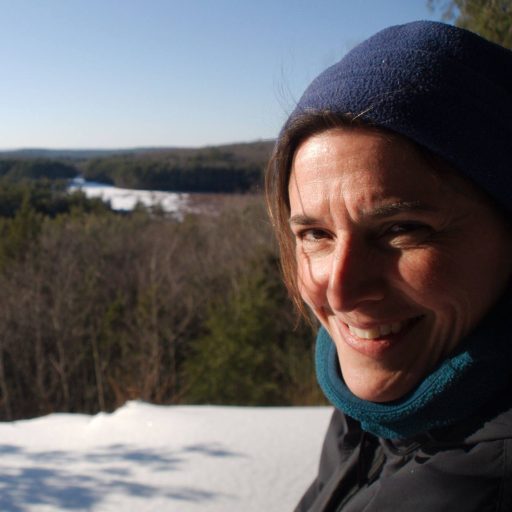
Most of the men I scroll past are likely on erectile dysfunction medication, because most men my age have difficulty maintaining an erection. I tell myself it’s the downside of our longer life expectancy; the longer we live, the more years we have with organs that don’t do what they are built to do for much younger people, in this case, making babies. If we all died at the ages people croaked a century ago, sexual dysfunction would be non-existent. Does that mean we should settle for less?

Finally, I get it. An online-dating profile is like a travel brochure for the country of a woman whose tourists are men—divorced, widowed, never married—with their kayaks and hiking boots and motorcycles, and—apparently—fishing gear. Men who “live each day fully,” as many say. Of course. That’s what you do on a vacation. “Have fun,” as the profiles say. Flash muscles; perhaps even beat one’s chest. Such men seem in search of a destination that involves abundant sport, which is perhaps why so many of their photographs show sweaty, rumpled, helmeted, shirtless, or gym-attired men. And men on the way to the gym, judging from the selfies taken in the front seat of a vehicle. They are looking for a place with mucho entertainment and lots of sex, but apparently, no “drama,” by which they mean conflict. The misuse of the word in the context of personal profiles heralds a treasure trove of data about the collective self-awareness, or lack thereof, of American men. And the idea that the curated persona expressed by a profile and half a dozen photographs is a shortcut to love, that we are still stuck in our Teen-Beat fantasies.
I’m looking at a hairless man on OKCupid who “liked” me—he’s my age, 59, and he has taken his selfie, the picture that’s supposed to convince me that he’s a catch, in the front seat of a car, alongside a dog that is licking his ear. Not a cute dog, either; one of those yippy hotdog-shaped dogs, and since the man is leaning back, I see more chin than face. Why is he advertising himself in this way? Women spend w-a-y-y-y more time polishing their appearance for the purpose of attracting a mate than men do; and the laziness to which men have grown accustomed and the assumption that, somehow, sitting in the front seat of a car with a canine equals attractiveness, tells you all you need to know. Women are buying cosmetics, magnetic eyelashes, and wigs; they’re getting Botox and butt implants and tooth-whiteners, while men are slouched in the front seat of a car canoodling with a dog. Or holding up a dead fish. It’s become a meme, the kneeling man offering up a lake trout, or a striper, or a catfish—except that 99 percent of the women I know could give a shit about a fish. I must ask myself: What kind of a woman does he hope to attract?
And why does he think a dead fish makes him a catch?
But I digress.
The body of a woman tells a story about the life it houses. In a single woman my age, the bones must be strong enough to carry her up a staircase while carrying full grocery bags. Her brain must be sharp enough to read, write, and think for herself, and also alert to the contempt that is mansplaining. Perhaps she is equipped with a sharp tongue that doesn’t hesitate to call out bullshit, though that is the ultimate killer of the elusive something that men (and women too, to be fair) refer to as “chemistry,” which many believe they will encounter on a first date. The woman who meets all other requirements can still eliminate herself from consideration by objecting to questions about her BMI, her lack of makeup or style (How many times have I heard, “You could be so pretty if you just grew your hair”?), and her preferences in bed—the all-too-often tawdry topics on a first date, which is in fact the interview of a tour-director to the country that is a woman.
What about the country that is this 59-year-old woman?
What does her topography tell us about a possible destination?
I thought about starting with my feet because they carry me, but I’ll start with what I least want to talk about: my hair. It’s fine and thinning, and though I know how to creatively disguise the hair deserts, I’m aware of the bare patch behind my ears and the vertical scar at the back of my head, put there by the surgeon who was correcting a neurological defect. What used to be a bright red line is now the palest ivory stripe under my chestnut fuzz. But my surgical scar is inarguably less noticeable than the thin spots elsewhere.
It’s an exceptional feat to artfully arrange chicken-fuzz on a head with symmetrical bare patches, then to lightly cement it in place with hair spray, knowing that rain or wind will undo the work. At home, I simply pull a cap over my skull and happily go about my business. I think I look rather cute under a cap, but I wonder if people in general suspect that I’m a cancer survivor and if men in particular find it granny-like. I try to forewarn prospective dates: “If you’re looking for tresses, keep going.” Sometimes I joke that I am “tresses-less” because it’s a tongue-twister. The main thing is, I’m over my middle-aged hair loss. I ditched a wig that didn’t look natural and cut my hair short so that it doesn’t require a lot of work, and most of the time, I could care less. Except for that one little piece of the time which, is shrinking as I approach sixty: when I’m on a date. Because even a guy who is a Q-ball expects a woman to have hair.
My last online prospect asked me: “Do you have wide or narrow hips?” and instead of being offended, I said, “I don’t know. I’m a size 6.” Newsflash: I’m almost 60, and I’m a size six. I have the same pair of pants that I wore when I met my adult son’s father, and they fit. But the prospect says he doesn’t know what a size 6 means. So the size that I have worked so hard to maintain is meaningful to other women but meaningless to a prospective date.
I don’t ask him his waist size, and by the time I think of a snappy retort about his emotional IQ, it’s too late. I’ve reluctantly agreed to meet him because his profile had no fish photograph, and he’s been to psychotherapy.
Next up: teeth. My are white and fairly straight as a group; however, the top and bottom halves of my jaw don’t align perfectly, leaving something of a crooked smile. That may be due in part to the aforementioned brain surgery. The right half of my face lacks physical sensation, other than intermittent pain that doctors describe as neuropathic, but for which a cause has not been identified. Sometimes my eye hurts or waters; sometimes I get little jabs in my cheek or an ache in the crevice between my nostril and cheek; and what is constant is the numbness, a feeling like Novacaine that’s not completely worn off. As a result, I can’t feel food that’s stuck in my teeth or ketchup that’s smeared on my face, or my nose running. I’ve gotten in the habit of proactively wiping my nose and flossing, but what I haven’t been able to do is command the right-sided musculature of my face to do what the left-sided musculature does. Hence the crooked smile.
I think of that brain surgery as part of a story akin to The Gift of the Magi, in which a man and a woman sacrifice what each most loves to afford a gift for the other. After my operation, I needed a place to convalesce, and my boyfriend took me in. When I was better, he asked me to marry him and I said yes, but he was promptly diagnosed with incurable cancer, and for the next six months, I walked with him toward death. With a red incision still soft and sore, I gave a dying man a honeymoon and said goodbye to him almost a year to the day after going under the knife. But when I am contemplating a new man, I don’t think about my valorous act. I think about facial asymmetry or a runny nose. My crooked smile may be quirky, as some describe, but a visible snot is not cute. I worry: Can a date with a visible booger ever be ‘fun’?
On the upside, my fair skin is pretty good shape, thanks to years of sunscreen. We all toasted ourselves crispy in the 1970s, but a small malignancy in my thirties cured me of that bad habit. The most prominent feature of my complexion is the lines around my eyes, a vestige of frowning when I am thoughtful or can’t find my readers, or laughing, all too often at myself.
From the neuropathic hemisphere of my face, I move on to something pleasant. Men would probably assume that’s my breasts, since that’s what they like. Women might assume I would trash them as stretched out or saggy. But I like them. They resemble the breasts on a marble sculpture by Da Vinci or Michelangelo, the kind where the artist used a male model then attached fruitlike half-spheres to the sculpture’s chest. That’s because they couldn’t use female models back then, but in my case, it’s because I have broad shoulders and strong arms—and that’s my next stop. When I look over my shoulder at the reflection of my back, I’m always surprised by the musculature that ripples between my shoulder blades and down to my waist. It’s not a typically feminine back and I don’t know if a man would like it, but when I lie on that back, the breasts that face up are round and firm, and tipped with brown-sugar strawberries, the same perky puckered fruit they were when I nursed my son almost 22 years ago.
My breasts are pretty and my back is handsome.
Perhaps that’s why I like my nose, while I’m at it. My face is probably more handsome than pretty, with high cheekbones, an elegant nose, and almond-shaped eyes the color of dark honey. I don’t think most men would call me pretty, but some have called me beautiful, and I think that’s because beauty need not be feminine.
A guy liked me online and messaged that he was “in love with Melanie.” I said that people invent one another when all they have is a profile, and he was likely doing so. No, no, he said; I was unlike other women he had encountered. We met, and he looked me up and down disapprovingly. After our brief stroll around town, this middle-aged, overweight, unemployed, and living-off-his-rich-mother guy emailed with the heading, “Not in love with Melanie,” apparently not realizing that his behavior fulfilled my prediction.
My hands: plain and strong yet graceful, as are my wrists and forearms, especially when I catch sight of myself leaning, chin-in-hand. I’m always surprised that they’re my hands, because they resemble my Sicilian grandmother’s hands. I knew at a young age that her hands had something noble in them; they didn’t need the adornment of nail polish or bracelets and rings. Adorning her hands would have been akin to putting tinsel on the statue of David, or more appropriately, the Pietà.
I am blessed with Nanna’s genes.
Then there is the belly, slightly swelled but taut, and below it, the curved scar concealed by the nest of now-gray hair that tells my baby was delivered with a scalpel. My bottom: ample and shapely but not fat. I read somewhere about a study in which men consistently chose five-foot, three-inch women of about 138 pounds, with a round bottom. That’s me, albeit with a few more pounds. I am a larger but proportional version of the fourth-grader in a 1971 photograph, beach-bound in a red-white-and-blue tank. I had straight white legs, round rather than slim with thighs that touched. A few years later, as an adolescent, I would yearn for my best friend’s skinny upper thighs; they didn’t touch, and she looked cool. Happily, age has brought some wisdom. No matter how many leg-lifts and squats I do, and no matter how many miles I log, I will never have an enviable “thigh-gap.” And at the age of 59, I no longer care. Three times a week I race-walk six to eight miles with an average pace under 14 minutes, and that’s damn good for anyone my age, woman or man.
A polyamorous guy wrote to ask if I would be open to filling the space in his life left by the polyamorous woman he was involved with—she was very busy and couldn’t be with him as often as he wanted. I would have to understand his iron-clad prioritizing of the other woman, who had much more in common with him than I did. He may as well have written, “I have some crumbs to give to a woman with no self-esteem.” I said that intimacy for me was about the vessel that is two adults in a committed relationship—and that my profile clearly stated I was monogamous. He wrote back to say, “You are very judgmental.”
I have to talk about the 59-year-old cooch. A woman my age has diminished estrogen that thins and dries out her vaginal tissues. This makes us sound like the orange you forgot about until you find it, puckered and hardened, at the bottom of the fruit bowl, the proverbial “dried-out prune” that women fear becoming. But worse than the fear is the shame. Women don’t announce when sex hurts or they simply avoid it. Secrecy breeds shame, and shame becomes surrender to asexuality. But the profiles of men who are 58, 60, 63 and 65 years-old trumpet that they want to have fun, and they don’t mean bowling.
Should I tell them that fun for me means seeing a physical therapist who inserts her fingers inside me and tries to ease the tightness borne of “short pelvic floor”? All that race-walking I do to maintain my size-6 body is also making my cooch as impenetrable as Nefertiti’s tomb. Vaginal physical therapy is not fun; it’s weird. I make it fun because what other choice do I have? My physical therapist and I chat about where she got her workout pants (which are at eye-level) and what I’m doing for Thanksgiving, all while she presses her liberally lubed-up finger on spots inside my vagina that hurt almost as much as early childbirth in the same body part that once registered the slow thrill of pleasure. If I don’t get PT for my cooch, I’ll never be able to have “penetrative sex,” as she calls it, never mind subtle pleasures; if I can’t get my own fingers in there, how will a penis ever make it inside?
I confess to liking penises (the real ones, not the plastic kind).
PT is a necessary unpleasantness in service of the bigger fun of romance. Because what if I skip PT and get to the sex, and it simply doesn’t work?
Most of the men I scroll past are likely on erectile dysfunction medication, because most men my age have difficulty maintaining an erection. I tell myself it’s the downside of our longer life expectancy; the longer we live, the more years we have with organs that don’t do what they are built to do for much younger people, in this case, making babies. If we all died at the ages people croaked a century ago, sexual dysfunction would be non-existent. Does that mean we should settle for less?
I’m not there yet. I admit it: I, too, want “penetrative sex.”
I’ll move on lastly to my legs, my strong white legs that were never designed to support cheerleading and don’t tan, only burn. I don’t have boney knee caps like JLo; one of them bears a long lumpy scar from knee surgery involving titanium screws. My right ankle clicks because of repeated strains—too many to ever again wear high heels, which makes sensible shoes my go-to. When the orthopedic doctor told me to stop rock-climbing and running, I got hugely depressed for about a year. Then I found waltzing—a form of couples dancing that is the choreographed equivalent of flirting. My deceased husband had been a professional dancer; by the time I met him, I understood that a man who knows how to lead a waltz can have practically anything he wants. It was our joke; he got good at leading, fast. Ironic, then, that the kayaking-fishing-cyclists don’t know this, or—even with all their athletic prowess—stumble with embarrassment through a first waltz that is clearly the last waltz.
When I’m 75 or 80 or 85, I’ll be able to track birds and climb stairs and maybe even mountains, but for sure I’ll be able to waltz in the dining room… and it is sublime.
Who cares whether I have JLo knees if I can still do that?
Vitruvian woman I am not, if there is such a female analog to Da Vinci’s buff man, his limbs extended to form a star inside a circle, demonstrating the ideal architecture of masculine anatomy. If Vitruvian man were alive today, he’d have an enviable body-fat ratio, if he had body fat at all. That’s not true of my middle-aged topography. The shape into which I best fit isn’t a circle, it’s a pear, which is a three-dimensional object rather than a two-dimensional shape. It may not be a perfect analogy, but it makes the point: My landscape is far from perfected, unless your point of reference is the lovely genus pyrus, a pear tree in the rose family. (I didn’t know that bit about the rose; it makes being a pear much more appealing.)
But what about the men online?
Vitruvian, they are most certainly not. The profiles on OKCupid and Match begin to look like packaged Lego pieces with so many fungible elements: After “Looking for someone to share fun,” there is some variation on a list consisting of hiking, skiing, tennis, weights, kayaking, snowboarding, bicycling, running, jogging, and swimming. (There are also lists of books read and music listened to, as if bulleted preferences are a proxy for personality. First, they are not; and second, I always count the women author or musicians in the lists. Not surprisingly, few.) The accompanying photographs include men in bicycle helmets and fluorescent cycling attire; in skimpy bathing suits while flexing muscles, even though most in my age group probably shouldn’t; and in formal suits, often hugging a female companion with a disturbing erasure-blob where a face should be—a lazy attempt at privacy. (If he’s going to scratch out her face, what might he do to mine?) The accompanying text says something like “I live fully for each day/I live each day fully” or “Life’s too short to sweat the small stuff” and—importantly—“Not interested in drama.”
What does any of that mean, exactly—especially living life fully with no drama? Anyone who’s not emotionally dead inside knows that life is drama. Yes, by drama, they probably mean conflict, but conflict isn’t drama; what it is, is an ordinary fact of being human. There is no such thing as a life without it, and our ability to resolve and repair conflict is the real selling point. Drama is altogether different: desire, resistance, vulnerability, longing, sexual heat, loneliness, and pushing-and-pulling. Sometimes it is shedding defenses or disclosing old hurts. On occasion, a conversation over limits or wants versus needs. And if a couple our age stays together, eventually there’ll be sickness or death or a birth, or some other life milestone, celebratory or mournful. There’s some drama for you—all of it, the stuff of being alive.
Men who set the bar high can be equally obtuse. “A lady who is cultured and well educated is an absolute must, as is being in great shape,” wrote a man who was 70, seeking a woman to share experiences that included wine-tasting and hiking in the Alps. He might have said, “Proletariat need not apply.” That would screen out the truly smart prospects.
I have to wonder about the scores of women—the former wives and girlfriends—behind these thousands of fish-bearing, kayaking men and the few with pedigrees. Do the women not live fully? Do they suffer from flabby bodies and flabby intellect? Do they call themselves “a special lady,” the wording so many men use? And are they all laden with drama (meaning conflict-prone)? I picture marital quarrels over the dog in the car or the hours that living life to the fullest likely consumes (e.g., working out, bicycling, polishing motorcycles, and kissing dogs) perhaps, whilst also avoiding “an exciting, emotional, or unexpected series of events or set of circumstances” (Webster’s definition of drama). I am reminded the old adage: “If you’ve only got a hammer, every problem resembles a nail.” Apparently, many men simply keep hammering away with the same old tool that likely ended prior relationships.
Wouldn’t it be better to write about having grieved, learned, and attained some new wisdom or self-knowledge? If they want to attract a different kind of woman, shouldn’t they strive to be more evolved?
An evolved man would desire a different topography, one that reveals the complexities of the life it houses. That man would want to know the anatomy of a woman’s interior—her bones, brain, and especially the heart that not only moves her blood but is the physical seat of love. A heart that is open to love is open to hurt—that’s the necessary mutual risk. I know, because my own heart has been broken. I fell in love with a man who died from incurable cancer and left me in a wilderness of grief for several long years. If I had avoided “drama,” I would have foregone the love of my life thus far. Still, we should all have a healthy dose of fear about falling in love—about its aftershocks—and approach it with due reverence. Because the risk of any truly loving attachment is abject lost, and for some, that risk is too great. I sometimes see a profile’s kayak as the marker for emotionally playing it safe—interesting enough to look crunchy, but still doing rather than being. Hesitant about play that is a little riskier, that asks two persons to acknowledge the thrilling drama that is, say, messy waltzing—a dance on the edge of the exciting and unexpected.
I’ve written a new profile. It says: If you can kayak, hike, run or bike miles, and downhill-ski but you can’t remember the last time you successfully resolved a conflict, expressed remorse and said, “I’m sorry,” did something selfless for a loved one, or took a risk to share a pain or vulnerability, don’t like me or wave hello. Years from now, when your knees are shot and you like napping more than kayaking, being able to communicate and express emotions will be way more important than all the running around. I want to be with that guy. Two old lives, hopefully wise, and as rugged and beautiful as mountains.
Fun…it’s overrated.
The destination in this country is love.
Dissent: A Journal of Sexuality, Fall 2024
 Melanie S Smith